

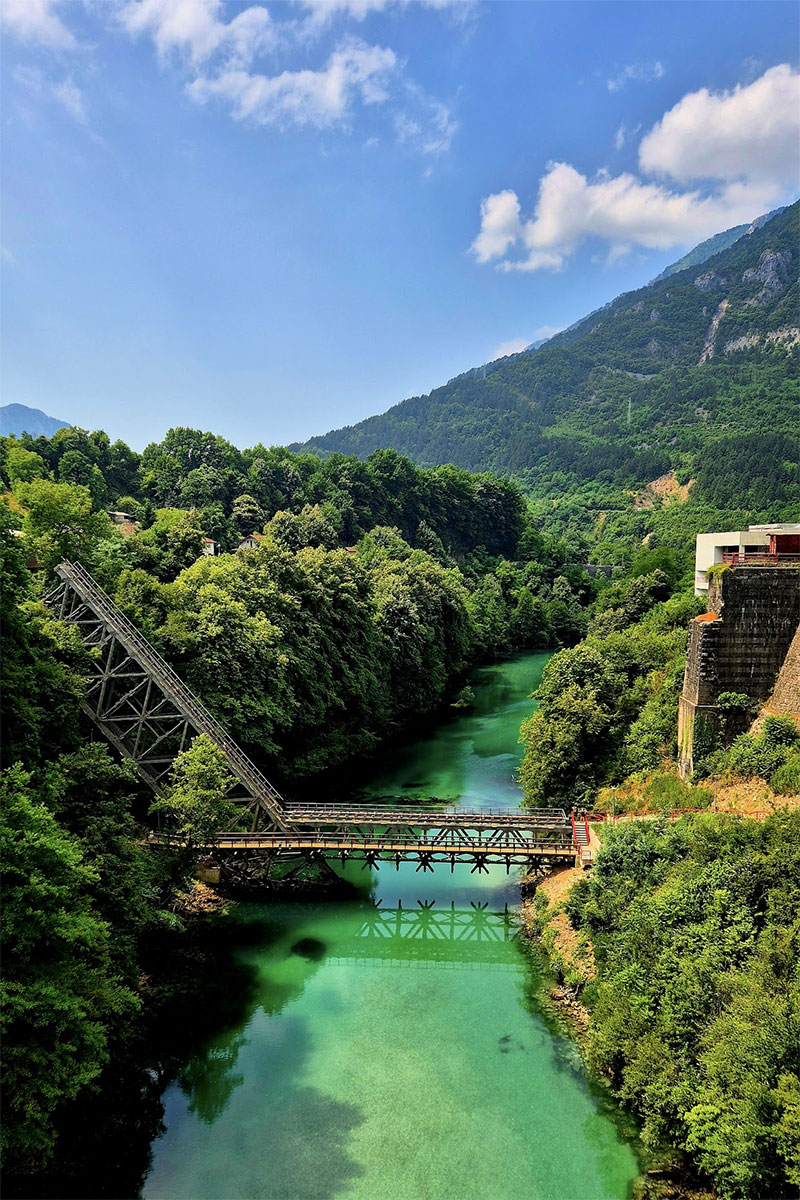
The demolished bridge represents the central feature of the “Battle on the Neretva” memorial complex and the main exhibit of the museum. The original bridge was built in 1888 during Austro-Hungarian rule and was part of the narrow-gauge railway Narentabahn, which connected the inland regions with the Adriatic Sea.
It was demolished during the Battle of the Neretva on March 3, 1943, by order of Josip Broz Tito, as part of a tactical deception intended to mislead the enemy about the movement of Partisan forces and the wounded.
After the destruction of the railway bridge, Partisan engineer Vladimir Smirnov – Volođa was tasked with constructing a new, improvised wooden bridge. Built in just 19 hours, this bridge enabled the passage of more than 4,000 wounded and sick, 80,000 refugees, and all Partisan units together with the Supreme Headquarters. It is estimated that around 100,000 people were evacuated across this bridge.
After a delay of several days, Wehrmacht forces arrived in Jablanica and began construction of a new bridge six months after the original had been destroyed. For the filming of the movie “Battle of Neretva”, the bridge was demolished again in 1968. At that time, a new road bridge was constructed upstream by the film crew, which is still in use today.
The demolished bridge on the Neretva remains a testament to an extraordinary act of courage and humanity, and an enduring symbol of Jablanica.