

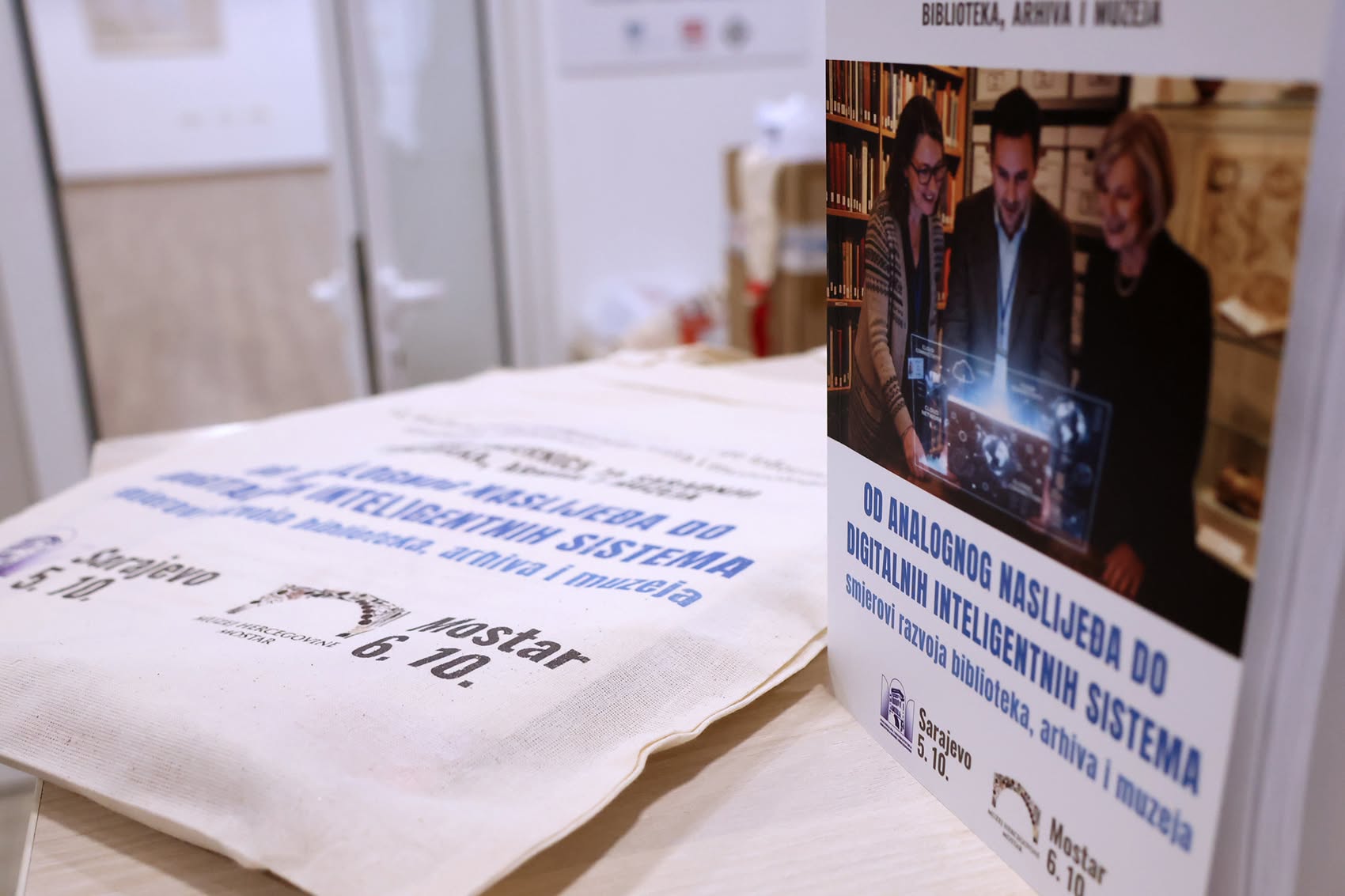


The PI Museum “Battle for the Wounded on the Neretva” in Jablanica participated in the 12th International Conference of the Association of Information Professionals – Librarians, Archivists and Museologists (BAM), entitled “European Guidelines for Cooperation between Libraries, Archives and Museums.” The two-day conference brought together experts from Bosnia and Herzegovina, Croatia, Serbia and Montenegro.
Lectures, thematic sessions and discussions addressed issues related to the digital transformation of libraries, archives and museums, the application of artificial intelligence (AI), digital humanities, digitisation and the accessibility of cultural heritage. The conference was opened by Adisa Žero, President of the BAM Association, who stated that the conference provides a platform for exchanging experiences and collectively reflecting on the future of heritage institutions.
“This conference provides a valuable platform for the exchange of professional knowledge, the presentation of innovative projects and the adoption of guidelines for future action. However, regardless of advances in technology and algorithms, the most important resource of our institutions remains people – information professionals who, through their dedication and expertise, preserve our country’s cultural treasures,” Žero stated.
Based on the thematic areas and objectives, a set of conclusions and recommendations was adopted, focusing on six key pillars for the development of the heritage sector:
- Strengthening regional cooperation and alignment with European guidelines. It is essential to establish a continuous cooperation network among libraries, archives and museums in Bosnia and Herzegovina, Croatia, Serbia and Montenegro. Guidelines were established for joint applications to European funding programmes and the development of cross-border projects aimed at protecting and promoting cultural heritage.
- Responsible and ethical application of artificial intelligence. The introduction of artificial intelligence tools in heritage institutions must be accompanied by clear ethical codes. AI should primarily be used to automate the processing and indexing of materials, recognise handwriting and text (OCR/HTR), and improve the user experience, while ensuring the preservation of authenticity and the scientific integrity of the materials.
- Interoperability, open data and standardisation. The need to adopt unified metadata and technical standards was emphasised to enable the integration of collections from different institutions – libraries, archives and museums – into unified digital ecosystems. The principles of Open Access were highlighted to ensure that heritage materials are easily searchable and accessible to researchers and the wider public.
- Digitisation and the long-term preservation of endangered heritage. Priority must be given to digitising endangered and rare collections. In addition to digitisation itself, it is essential to develop long-term digital preservation systems to ensure that digitised materials remain functional and protected against technological obsolescence and data loss.
- Continuous education and strengthening the digital competencies of professionals. A programme of systematic professional development was proposed for information professionals, including librarians, archivists and curators, focusing on digital humanities, data analytics and the use of modern software solutions. The aim is to transform heritage institutions into modern, intelligent scientific and cultural centres.
- Education as a strategic foundation for the development of libraries, archives and museums. The BAM Association of Librarians, Museologists and Archivists emphasises the need for stronger links between higher education institutions and heritage institutions through the development of joint study programmes, professional internships, research projects and lifelong learning programmes.
In this way, it is necessary to cultivate new generations of professionals capable of responding to the challenges of digital transformation while actively contributing to the protection, understanding, interpretation and accessibility of cultural heritage.
The conference concluded with the ceremonial presentation of the BAM Awards for Librarian of the Year, Archivist of the Year and Curator of the Year. The Librarian of the Year award went to Arijana Alispahić. Almira Alibašić received the Archivist of the Year award, while Ermin Lagumdžija was named Curator of the Year.
The BAM Association continues its long-standing work of connecting professionals in librarianship, archival science and museology, while creating opportunities for cooperation in the protection, research and presentation of cultural heritage in an era of rapid digital transformation.